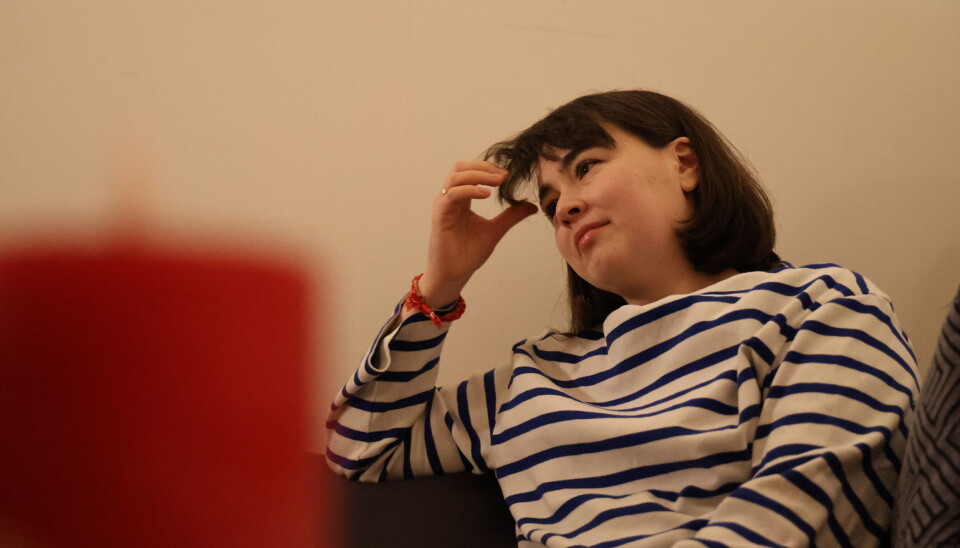
“Everything inside me tightened”: Journalist Anna Yarovaya was detained by the FSB
The journalist, who once wrote about attempts to erase the history of political repression, was taken in for questioning by the Federal Security Service (FSB) when she travelled from Finland to visit her parents. Russian security officers were waiting for her outside her family home and hinted that she could face a criminal case for high treason.
“When the security officers mentioned treason and 12 years — the minimum sentence under that article — the most terrifying thing for me was that I might never see my children again. I understand my parents, who during the search pleaded, ‘Take us instead.’ I wasn’t afraid for myself or for my husband. I was afraid that I would never see my children again,” Yarovaya says.
She is speaking to Barents Observer in Kirkenes, Norway, just 10 kilometres from the Russian border. Two days earlier she had been sitting in an FSB office in Petrozavodsk, where officers questioned her about colleagues who had left the country and made thinly veiled references to a possible treason charge — a crime that under current Russian law can carry a life sentence.
A dual Russian and Finnish citizen, Yarovaya travelled to Russia after attending the Barents Spektakel festival in Kirkenes at the end of February. She had prepared for possible questioning at the border and carried a “clean” phone for inspection. This time she crossed without difficulty and went on to Petrozavodsk to see her parents, who had long been waiting for her visit.
The following day, 26 February, Yarovaya left her parents’ flat. A minibus was parked outside the entrance. Masked men armed with automatic weapons jumped out and ran towards her. They twisted her arm behind her back — the one holding her phone.
“They said they had information that I was working for the Finnish security police, Finnish Security Intelligence Service (SUPO). I realised this was serious. It was brutal.”
The officers said they needed to carry out an “inspection of the premises”. In practice, the only difference from a search was the absence of a court warrant — apparently the FSB had not obtained one before Yarovaya’s arrival in Petrozavodsk. According to the officers, the detention was prompted by an anonymous tip-off.
“Allegedly, someone had reported that I was an agent of Finland’s internal security service. They said they would simply inspect the flat and release me. I told them everything they wanted to know was publicly available online. Why the arm-twisting, the automatic weapons, the masked men? I’m not a criminal, not a terrorist. They replied, ‘It’s our job.’”

Yarovaya spent two and a half hours with the officers in her parents’ flat. Her laptop and phone were confiscated.
“They started putting my equipment into a black rubbish bag. I asked, ‘Don’t you have money for something more appropriate?’ They replied, ‘We manage within the budget.’ So there’s enough budget to stake out an unarmed woman for 24 hours with automatic weapons — but not enough for a proper evidence bag.”
After the “inspection”, the officers read out a report stating that the FSB was verifying information about Yarovaya’s possible cooperation with Finnish intelligence services, which could be classified as high treason.
“Everything inside me tightened. This is nonsense — this can’t be happening to me,” she recalls.
In recent years, Yarovaya has not worked permanently for any media outlet. She studies in Finland and focuses on her own creative projects unrelated directly to Russian politics. Nonetheless, when crossing the border she had mentally prepared herself for the possibility of some administrative charge — for example, cooperation with an “undesirable organisation” or “discrediting” the army. She had never imagined she might be suspected of such a grave crime.
“My presence in Russia is undesirable”
The officers took her to the FSB building on Andropov Street in Petrozavodsk for a two-hour “interview”. They repeatedly asked whether Finnish intelligence had recruited her.
“They asked if I had filled in any forms or taken part in any surveys. I never have, and I told them so,” she says.
They also discussed articles she had published in the Finnish newspaper Karjalainen, in which she wrote about her trips to Russia, including reflections on the country’s militarisation and the authorities’ efforts to recruit fighters for the war against Ukraine.
FSB officers were keenly interested in the fate of Karelia-based journalists and activists who had left Russia. They asked about Valery Potashov, an independent journalist forced to flee after a second search of his home. They wanted to know how former Karelian journalist Andrei Agapov, now living in Joensuu and actively supporting the Ukrainian army, had reacted to treason cases. They also mentioned Pavel Andreev, co-founder of the cultural space Revolt Centre in Syktyvkar and of the outlet 7x7, where Yarovaya once worked. Andreev, too, has been charged with treason.
“Do you share Andrei Agapov’s position regarding the ‘special military operation’?” the officers asked, looking at photos of the two on her unlocked phone. “When did you last meet Pavel Andreev?”
At the end of the questioning, the officers asked whether she knew the wording of the Criminal Code article on high treason. An FSB officer read it aloud, printed it out and handed it to her.
“My eye started twitching. He read out the paragraph stating that a person who has committed actions that could be interpreted as treason, but who voluntarily reports this to the FSB, is exempt from criminal liability. ‘So if you remember anything, call the duty officer,’” Yarovaya recalls him saying.

She left the FSB building determined to leave the country immediately. With no means of communication, she went to the nearest shop and bought the first phone she could find. She met her relatives; they considered that it might be their last meeting for years.
“I was made to understand that my presence in Russia is undesirable — but I was given the chance to leave,” she says.
Two days later, she crossed the border. A border guard asked when she planned to return.
“Return where?” Yarovaya asked.
“Well, to Russia.”
“I don’t know.”
“Very well. I’ll note that down. I have no further questions.”
***
Anna Yarovaya and her husband Gleb left Russia in 2018, partly because of their professional activities. Gleb Yarovoy wrote extensively about penal colonies in Karelia; his investigation into torture at Correctional Colony No. 7 in Segezha received the Redkollegia award. At one point, they began receiving signals that Karelian security officials might be keen to send the journalist to the very places he had described in his reporting. On one occasion, he was detained under the pretext of testing for alcohol and drug intoxication; the tests were negative, but he was prevented from attending a protest rally he had intended to cover.
Anna Yarovaya herself wrote widely about repression and about the criminal case against historian Yury Dmitriev. Her article on attempts by the authorities to rewrite the history of Stalinist repression also received the Redkollegia award.