Collateral damage: Svalbard governor’s website blocked in Russia
Websites belonging to the Governor of Svalbard and the newspaper Svalbardposten have become inaccessible from within Russia. When users attempt to visit these sites, the pages fail to load; however, they can still be accessed using a VPN.

Reports of the issue first surfaced in late March, but the Barents Observer has since established that the problems began as early as November 2025. In addition to the governor’s website and Svalbardposten, the website of Store Norske, the company that previously operated coal mines on Svalbard, as well as the official website of the local authorities in the town of Longyearbyen, have also been affected.
Notably, these sites have not been added to Roskomnadzor’s official register of banned resources, nor have they been subject to restrictions imposed by the Prosecutor General’s Office, as was the case with the Barents Observer itself.

Svalbard’s governor, Lars Fause, told the Barents Observer he was unaware of the situation.
“It is very unfortunate,” he said, “as many people are thereby losing access to a significant amount of important information about Svalbard and the governor’s activities.”
Mikhail Klimarev, an internet security expert and head of the Internet Protection Society, suggested that the issue may stem from technical aspects of how blocking mechanisms are implemented. The Svalbard websites themselves have not been directly banned; rather, they use IP addresses that have fallen under restrictions. He likened the situation to a block of flats in which one resident breaks the rules, and the police—unable to access the individual flat—simply weld shut the main entrance to the entire building.
Most websites do not have their own dedicated IP address. Instead, they are hosted on shared infrastructure or cloud services (such as AWS or Cloudflare), where thousands of websites may operate from a single IP. When a user enters a web address, the server identifies the requested site using a mechanism known as SNI (Server Name Indication).
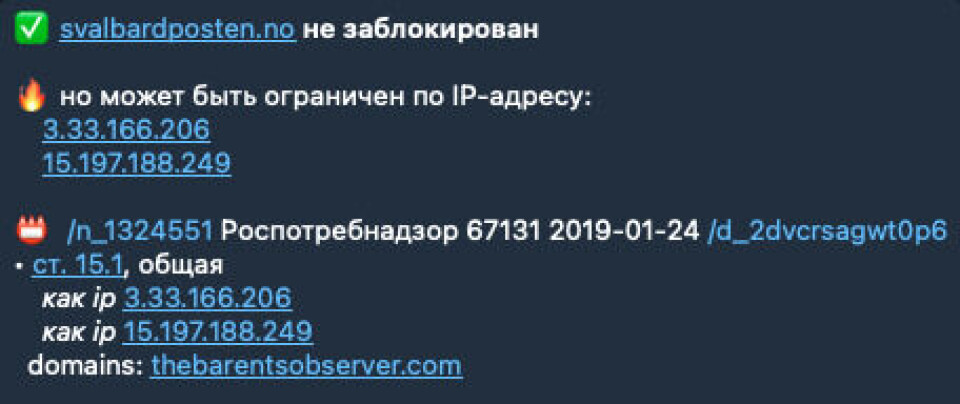
For example, the domain thebarentsobserver.com has been blocked via two IP addresses. While svalbardposten.no - the newspaper in Longyearbyen - itself is not banned by Roskomnadzor, it uses the same IP addresses and therefore cannot be accessed from Russia either.
A similar situation affects the Svalbard governor’s website. In this case, the difference is that the same IP address also hosts an online casino that has been blocked by Roskomnadzor.
There are several ways for affected websites to restore accessibility within Russia. One option is to request a new IP address from the hosting provider. If the new address is not on Roskomnadzor’s blacklist, access is typically restored almost immediately once DNS records are updated.
Alternatively, website owners can purchase a dedicated IP address. This ensures that restrictions applied to other sites on the same server do not affect their own. Most cloud providers, including Cloudflare and AWS, offer this service for an additional fee.
In theory, there is also a legal route: a website owner or hosting provider can submit a formal request to Roskomnadzor to have a specific IP address removed from the block list on the grounds that it hosts legitimate resources. In practice, however, this approach has proven ineffective.
For instance, in 2018, the company Zhivaya Fotografiya experienced service disruptions after its IP addresses were blocked as part of efforts to restrict Telegram. In August of that year, Moscow’s Tagansky District Court dismissed the company’s lawsuit, ruling that the regulator’s actions were lawful and justified. The court concluded that restricting access to entire subnets was a necessary measure to enforce the ruling against the messaging service, and that the rights of third parties were secondary to the state’s information security objectives.
Nevertheless, the Governor of Svalbard and other affected website owners do have technical means to restore access in Russia. The main challenge, however, is that they must first become aware that their sites have been blocked.