
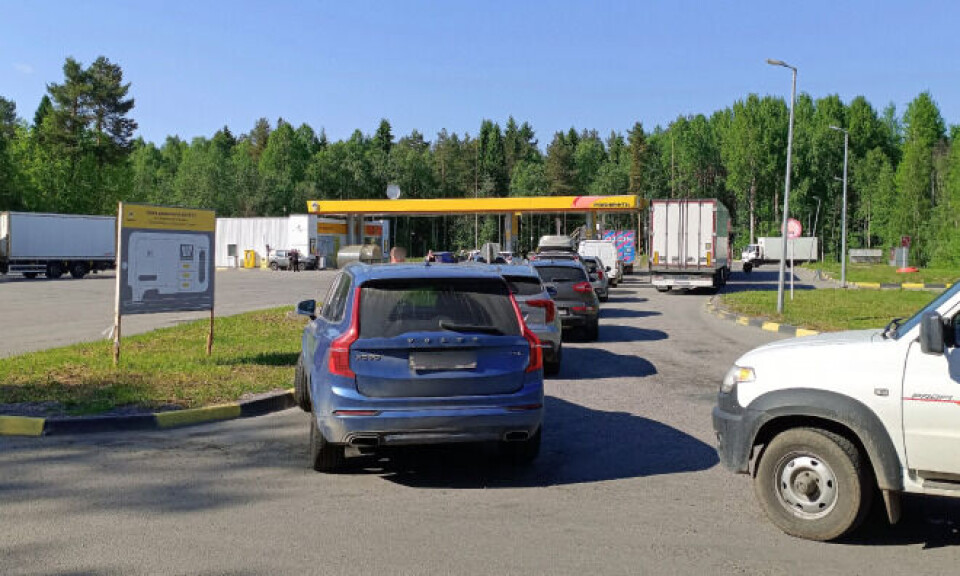
Gasoline sales are being restricted along Kola highway amid the fuel crisis in Russia
Drivers say the situation at some filling stations has led to lengthy queues, fuel rationing and sharp price increases, raising concerns about the stability of fuel supplies across northwest Russia.

Motorists returning to Murmansk from journeys along the Kola Highway are reporting fuel shortages across Karelia and southern parts of the Murmansk region.
Russian fuel production is severely affected by waves of Ukrainian drone strikes on oil refineries.
According to reports, some filling stations in Karelia have introduced limits on fuel purchases, with restrictions ranging from 20 to 80 litres per customer depending on location. In the Loukhi District, motorists have been limited to 20 litres of petrol per vehicle, and fuel may only be dispensed directly into vehicle tanks, with filling jerry cans prohibited. Station staff have reportedly warned that supplies could become so limited that sales may eventually be restricted to emergency services. In Kostomuksha, a limit of 80 litres per customer has been introduced.
In Segezha, motorists report that the price of AI-92 petrol at independent filling stations has reached 83 roubles per litre, while AI-95 and diesel are selling at even higher prices. Fuel prices have been rising across Karelia, with official statistics showing that AI-92 petrol increased by 1.7 per cent and AI-95 by 1.4 per cent in early June — roughly three times the rate recorded in May. Prices have continued to climb, with Kareliastat reporting further increases between 2 and 8 June, including a 0.5 per cent rise in diesel prices and increases of between 0.3 and 0.4 per cent for various grades of petrol.
The shortages have not been confined to independent operators. Reports indicate that some privately owned filling stations in northern Karelia have either closed temporarily or are selling fuel at heavily inflated prices. By 9 June, even federal filling station chains in Karelia had reportedly begun introducing restrictions on petrol sales, prompting the regional Ministry of Industry and Trade to acknowledge that the problem was spreading beyond private operators.
At larger chain-operated stations, queues can reportedly last for more than an hour. Similar problems have been observed along sections of the Kola Highway, including around Zelenoborsky, where drivers face long waits for fuel during the peak holiday season. Local broadcaster TV-21 attributed the queues to the start of the summer travel period, but also acknowledged that infrastructure along the route is struggling to cope with increased traffic heading south. The stations most affected were identified as those in Zelenoborsky and the Karelian village of Pushnoy.
The situation has become increasingly visible in local communities. On 10 June, a filling station in the village of Essoila, in Karelia's Pryazhinsky District, reportedly ran out of petrol entirely. Local residents told the publication Faktor that they were unable to refuel, while a notice displayed at the station stated that fuel stocks had been exhausted and that no new deliveries were expected until the end of the week.
Motorists travelling south report that conditions begin to improve further into southern Karelia and the neighbouring Leningrad region. However, reports of shortages and restrictions are now emerging from numerous regions across Russia. Similar fuel rationing measures, ranging from 20 to 50 litres per customer, have also been recorded in the Arkhangelsk region.
Russian authorities have not officially acknowledged a fuel crisis, instead describing the situation as "temporary difficulties related to disruptions in supply chains." Karelia's Minister of Industry and Trade, Svetlana Astakhova, has repeatedly insisted that there is no fuel shortage in the republic. According to Astakhova, the temporary restrictions are intended to ensure the rational distribution of remaining stocks until new deliveries arrive. She has attributed the pressure on supplies to increased demand during the holiday season, as well as changes in payment arrangements within the fuel supply chain.
Nevertheless, regional authorities have recognised the seriousness of the situation. Following reports that restrictions had spread to national fuel retailers, the Ministry announced plans to convene a task force to develop measures aimed at stabilising the fuel market. A broader working group involving municipalities, regional authorities and business representatives has since been established to monitor developments and coordinate responses.
Questions about the underlying causes of the shortages have intensified following comments from Murmansk businessman Maxim Belov, owner of the Evecta chain of filling stations on the Kola Peninsula. Belov reported serious disruptions to fuel deliveries, stating that oil refineries had sharply reduced shipments and that suppliers had been unable to meet market demand for approximately a week.
According to Belov, when fuel is available, the cost of transporting it to northern regions often makes distribution economically unviable. He warned that purchasing and delivering fuel to the Murmansk region currently costs more than the retail price, rendering operations unprofitable. As a result, he said some filling stations could eventually be forced to close if shortages persist.
Belov also noted that fuel reserves at certain stations are sufficient for only a few days, raising concerns that shortages could spread further across the region.
While officials continue to attribute the disruptions primarily to seasonal demand, industry analysts point to broader supply-side problems.
They note that Russian fuel production has been affected by a series of Ukrainian drone strikes on oil refineries. In May 2026 alone, a record number of attacks reportedly damaged refining infrastructure and disrupted production, contributing to tighter fuel supplies across the country.
For now, authorities insist that the situation remains under control. Yet with rationing expanding, queues lengthening and prices continuing to rise, motorists travelling along the Kola Highway are increasingly encountering the effects of what appears to be a widening fuel supply crisis in northern Russia.


