
Trump’s new envoy to Norway travelled straight from the Royal Palace to the Russian border
Immediately after presenting his credentials to King Haakon, Ambassador Michael Kavoukjian flew north to Kirkenes, where Norway’s Minister of Defence took him on a guided tour of the border with Russia.
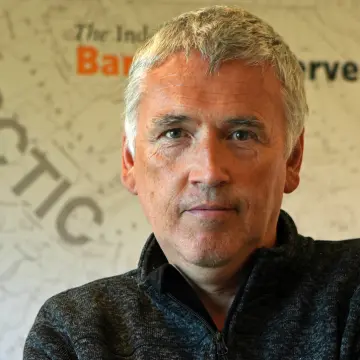
Donald Trump’s new ambassador to Norway did exactly what he promised during his confirmation hearing before the Senate Foreign Relations Committee in May.
“The first thing I would do is present my credentials to the king,” Michael Kavoukjian told senators.
He then outlined his next move:
“I would then plan to immediately get on a plane and fly to Kirkenes on the Russian border with top-level Norwegian military and intelligence officials to hold meetings with them and local officials about the Russian and Chinese activities on the border and the threats that they’re perceiving there as well as in the Greater Arctic.”
On November 5, Kavoukjian wasted little time putting his words into action.
The new ambassador, himself a former CIA officer, presented his credentials to King Haakon in the morning. Just a few hours later, a US Air Force Beechcraft C-12D Huron took off from Oslo Gardermoen Airport, bound for Kirkenes.
On board were also Norway’s Minister of Defence, Tore O. Sandvik, State Secretary Eivind Vad Petersson of the Ministry of Foreign Affairs, and Norwegian Army Chief Major General John Olav Fuglem.
The small propeller aircraft would normally reach Kirkenes in around three and a half hours. But strong headwinds extended the journey, forcing the pilots to make an unscheduled refuelling stop in Rovaniemi, northern Finland.
The stop was notable in itself. Rovaniemi is home to the Finnish Air Force’s Lapland Air Wing, which received its first US-built fifth-generation F-35 multi-role fighter jets in September. There was, however, no time for a closer look at the F-35 base. The ambassador still had to reach Kirkenes before midnight to keep his promise of visiting the town on his first day as US Ambassador to Norway.
Dinner with the Mayor
Despite the late arrival, Ambassador Michael Kavoukjian went straight to dinner with Kirkenes Mayor Magnus Mæland to hear firsthand how local residents view developments in the borderland with Russia and the challenges facing their community.

“I had a very pleasant meeting with the Ambassador," Mæland told the Barents Observer.
"He was clearly interested in both the geopolitical and geo-economic realities facing the municipality. I regard the Ambassador as an important partner for our municipality.” the Kirkenes Mayor added.
Early Friday morning, Ambassador Kavoukjian met with Norway’s first line of defence: soldiers from the Garrison of Sør-Varanger’s (GSV) Ranger Battalion at Jarfjord Border Station.
Norway shares a 198-kilometre land border with Russia’s Kola Peninsula, a strategic military stronghold for Moscow. Around 100 kilometres from the Norwegian border lies Gadzhiyevo, a naval base that hosts nuclear-powered ballistic missile submarines. Some 200 kilometres away is Olenya air base, from which Russian strategic bombers regularly take off on missions involving cruise missile attacks that terrorise civilians in Ukraine.
For this reason, Ukraine has also carried out drone attacks against targets on the Kola Peninsula.
"Unchanged threat assessment"
Like other NATO countries bordering Russia, Norway faces an immediate security concern: stray drones or those hijacked by Russian electronic warfare could cross the border at any moment, bringing the war in Ukraine dangerously close to Norwegian territory.
Despite the heightened concerns over drone activity near the border, Norway’s Minister of Defence, Tore O. Sandvik, told the Barents Observer that the country’s threat assessment remains unchanged.


“There is no new, specific threat to Norway,” Sandvik said, as he showed the Barents Observer one of the NASAMS sensors deployed alongside the Ranger Battalion GSV in Kirkenes.
The state-of-the-art system is designed to detect and track drones.
“We have seen in other parts of Europe that drones can stray off course, not least because of heavy electronic jamming. Air defence is therefore an important part of our total defence system, which we are building up in several layers,” the minister said.
Are you concerned that Russia could take control of Ukrainian drones and deliberately send them into Norwegian territory in eastern Finnmark as a false-flag operation?
“We are prepared for different scenarios, and we will be able to handle them,” Sandvik replied.
Are you and the Ambassador discussing Norway’s self-imposed restrictions on surveillance aircraft from other NATO countries operating in eastern Finnmark, and the possibility of lifting them, as other NATO countries bordering Russia have done?
“Norway and the United States maintain a very close, good and open dialogue about everything we need to protect Norway and to serve as a front line of defence for the United States as well."
No NATO aircraft near the border
Norway maintains a Cold War-era policy restricting allied military aircraft from operating over eastern Finnmark, the part of Norwegian sovereign airspace closest to the Russian border. As a result, US, British and Swedish signals intelligence aircraft can fly to the northern tip of Finland, close to Russia’s Kola Peninsula, but are not permitted to operate over the Kirkenes area on the Norwegian side of the border.
Defence Minister Sandvik added:
“We have a good dialogue with all our allies. We have a good overview of the situation and are well coordinated with our closest allies on how we operate in our neighbouring areas.”
High level meeting with FSB
Although there are no political-level contacts between Norway’s Ministry of Defence and Moscow, Norway is one of the few NATO countries sharing a direct border with Russia that continues to keep the door open to military contact.
A hotline between the Norwegian Joint Headquarters (NJHQ), near Bodø, and the Headquarters of Russia’s Northern Fleet in Severomorsk is used to discuss incidents at sea and in the air. Its purpose is to prevent misunderstandings that could lead to unintended escalation in the Arctic.
Earlier this week, Vice Admiral Rune Andersen, Chief of the Norwegian Joint Headquarters, met Major General Andrei Kudimov, head of the paramilitary FSB’s Border Directorate for the Western Arctic.


Meetings like this are intended to maintain a channel of dialogue on fisheries inspections in the Barents Sea, carried out by the Norwegian Coast Guard and its Russian counterpart, the FSB Border Guard Service. The two sides also exchange views on monitoring and controlling the land border.
Media unwanted
The Barents Observer spoke to Vice Admiral Rune Andersen later that evening, after the official meeting minutes with the FSB had been signed.
This year’s annual meeting was due to take place in Russia, following last year’s meeting in Norway, but was again held on the Norwegian side. Vice Admiral Andersen declined to elaborate, referring only to what the Barents Observer has previously reported on the matter.
Why did the Armed Forces not invite the media to this meeting, as has been the tradition for the past 20 years?
“Given the situation we are in now, I don't think that would be appropriate. We want to preserve this channel and the opportunity to meet and discuss the one issue we can, after all, talk about,” Rune Andersen said.
Was keeping the meeting out of the public eye a request from the FSB or your own decision?
“We have chosen to keep a low profile to ensure that we can continue to hold these meetings. With a more challenging international and security situation and strained relations with Russia, it is important to preserve and protect the few channels of communication we have.”
So FSB’s desire to influence over Norwegian media has spilled over to the Norwegian side?
“No. I believe it is right to protect the one small forum for meetings that we have, and to act in good faith to ensure that we can continue to meet and discuss the issue we agree on.”
Would you fear that the meeting might not take place next year if the media were present, even just to take photographs outside?
“No, I don't think so," Andersen said. "We are holding this meeting between the two parties without making it any more public.”


