

PM Støre fears Russia will deploy more nukes in the Arctic, as New START Treaty expires on February 5th
More uncertainty can push Russia to a higher alert, deploying more tactical and strategic nuclear warheads on board submarines sailing out from the Kola Peninsula.
Today marks the final day of the last remaining nuclear arms control agreement between the United States and Russia. It is the end of an era that began in 1969, when Moscow and Washington D.C. first launched the SALT I negotiations.
Signed by the two presidents Obama and Medvedev in Prague 2010, and entering into force on February 5, 2011, the New START Treaty limits each country to having no more than 1,550 deployed nuclear warheads on intercontinental ballistic missiles and heavy bombers.
No deal means no legal binding limits on the total number of nuclear warheads.
If launched, such weapons can reach the adversary in approximately 30 minutes. The shortest distance to exchange doomsday weapons between Russia and the United States via space is across the Arctic.
Russia's largest concentration of nuclear weapons is on the Kola Peninsula. Both multirole and strategic submarines of the Northern Fleet carry nuclear weapons. Many more warheads are in storage ready for deployment.
Gadzhiyevo, a short 100 kilometres from the border with Norway, is home to the 31st Submarine Division consisting of the Delta-IV and the Borei-class ballistic carriers. Each of the submarines can carry 16 missiles and each missile can be armed with at least six warheads.
The New START Treaty stipulated joint on-site inspections, meaning U.S. experts could travel to Gadzhiyevo and count the number of warheads on the loaded missiles.
A true concern
"I think this is a real and true concern," said the Norwegian Prime Minister Jonas Gahr Støre when asked by the Barents Observer about the possibility that Russia could increase the number of nuclear warheads in the vicinity of northern Norway.
"I regret that some of these hard-won games in international stability - arms deals - are expiring," Støre said and called for the nuclear powers to "take responsibility."
On Wednesday, Jonas Gahr Støre was in Tromsø attending the Arctic Frontiers conference, an annual venue that has been promoting international cooperation among Arctic states since 2007. However, this year combating climate change and encouraging circumpolar science were overshadowed by security concerns: Russia's all-out war against Ukraine and Trump's desire to acquire Greenland.
Tactical nukes
While the New START limited the numbers of warheads with intercontinental range, Støre emphasized the importance of also keeping eyes on tactical nuclear weapons. These are weapons attached to cruise missiles with shorter range. If launched from Russia, or the waters of the North Atlantic, they can reach targets in Europe.
"It was on the agenda when I met the Polish foreign minister two days ago," Støre said and elaborated by revealing a story not previously known to the public:
"When he [Radosław Sikorski] and I were foreign ministers together, some 15 years ago, we took the initiative to map the tactical nuclear weapons in our part of Europe and tried to get them into some kind of framework deal. They are spread around and contributed to insecurity."
Russia "completely rejected" this framework deal, Støre said.

It is unknown how many tactical nuclear weapons Russia has on the Kola Peninsula. A few are likely deployed on naval cruise missiles, like the Tsirkon and Kalibr. Many more are stored on shore at two of the submarine bases and nuclear support facilities on the coast of the Barents Sea.
There is also a central nuclear weapons storage unit inland on the Kola Peninsula, a two-to-three hour drive south of Murmansk.
Threat to carrier strike group
The Northern Fleet has three Yasen-class submarines believed to be capable of carrying such weapons: the Severodvinsk (K-573), the Kazan (K-561) and the Arkhangelsk (K-564).
They are the most quiet - and difficult to detect - of all Russian submarines.
Last autumn, the Barents Observer reported about the Kazan and the Arkhangelsk, both of which were at sea when the U.S. aircraft carrier USS Gerald R. Ford sailed outside northern Norway.
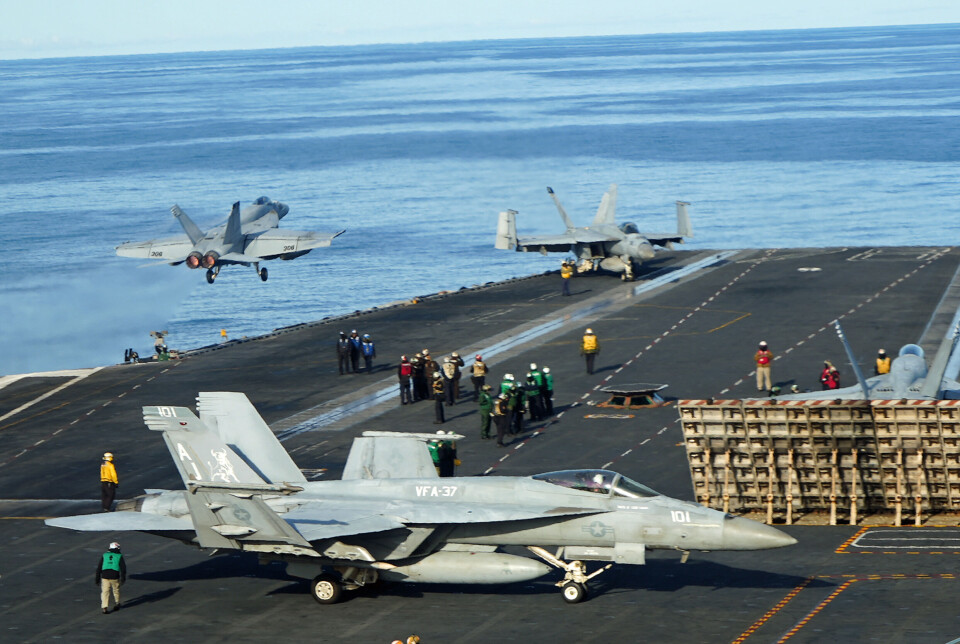
In connection with Russia's full-scale war against Ukraine, tensions in northern waters have been increasing to levels not seen since the Cold War.
The Treaty built trust
"The Northern Fleet remains the strongest part of the Russian Navy," said Katarzyna Zysk, a professor at the Norwegian Institute for Defence Studies.
Zysk is an expert on Russia's military doctrine, maritime safety and Arctic security. She believes the nuclear capabilities on the Kola Peninsula will be more important for Moscow now as the predictability that followed the New START Treaty is gone.
"It can stimulate more worst-case planning," she said.

"New START’s central value was not only in the numeric limits, but also in the predictable flow of notifications, data exchanges, on-site inspections and other transparency mechanisms that reduced uncertainty and helped sustain predictability about the other side’s deployed forces."
The treaty provided for 18 on-site inspections per year for US and Russian inspection teams.
"Once those routines end," Zysk explains, "Russia will have to plan against a US force posture that is less observed, hence a higher degree of uncertainty."
As a result, the professor fears, Russia and the United States can be pushed toward a higher alert and increased positioning of nuclear weapons.
"Increasing the quality and availability of the sea-based leg is clearly in Russia’s interest and cannot be excluded," Zysk explains.
However, she underlines that this will only be a likely scenario if Moscow believes that the overall strategic environment is worsening.
Undiminished funding
Although Russia's wartime economy is struggling with rising prices and deteriorating financial outlooks, funding is undiminished for new nuclear-powered submarines at the giant Sevmash yard in Severodvinsk.
Eight Borei and Borei-A classes of strategic submarines have already been rolled out from the ship hall and are in operation with Russia's two nuclear fleets, the Pacific and the Northern. The latest, Knyaz Pozarsky, came north to Gadzhiyevo in August last year.
Each of those submarines is armed with 16 Bulava missiles with intercontinental range. If there are six warheads attached to each missile, one submarine on patrol in the northeastern Barents Sea or under the Arctic sea-ice could potentially carry as many as 96 nuclear warheads.
Another two Borei-A class submarines are under construction and two more are planned.
Strategic submarines, and the ballistic missiles themselves, are among the most expensive parts of the nuclear triad.
More nukes on each missile
Professor Katarzyna Zysk does not believe the Kremlin will have to wait for more submarines or Bulava missiles to increase the number of nuclear warheads now as the START Treaty expires.
“Russia can gain numbers faster by uploading warheads on existing systems rather than building additional platforms and missiles,” she explained.
Deploying more and longer patrols will add strength to deterrence, Katarina Zysk suggests.

The Barents Observer has previously published several articles showing satellite images revealing a major build-up of bunkers for new missiles at the bases of the Northern Fleet on the Kola Peninsula.
Potentially, Russia could add dozens of nuclear warheads to submarine missiles within a few weeks at the Northern Fleet's nuclear support facilities in Gadzhiyevo and Okolnaya (near Severomorsk).
The worsening security situation in the high north draws more attention from Europe.
Present in Tromsø this week for the Arctic Frontiers conference was also Kaja Kallas, the European Union's High Representative for Foreign Affairs and Security Policy.
"The Arctic is no longer a quiet corner on the map. It is the front line of the global power competition," Kallas said.
She made clear that the Arctic is critical for transatlantic security. "It will require more attention, more resources and - yes - more hard power."
"Russia's full-scale war in Ukraine has increased tensions across Europe, also in the Arctic," Kallas said.
She herself was born in Estonia, at a time when the country was occupied by Moscow and part of the Soviet Union.
"Europe must catch up"
"Moscow has re-opened and modernised Soviet-era military bases in the High North. One of the world’s largest concentrations of nuclear weapons is located on the Kola Peninsula, right across the Norwegian border."
"The Arctic has also become a testing ground for Russian missiles," the EU's foreign policy chief said.
"Europe must catch up with years of Russian military build-up in the region."

Last week, the Bulletin of the Atomic Scientists set the so-called Doomsday Clock at 85 seconds to midnight, the closest the Clock has ever been to midnight in its history.
The board of scientists at the same time called for urgent action to limit global nuclear arsenals.


